Wednesday, September 8, 2010

Optical Speedbumps Create Illusion of Little Girl Darting Out In Front Of You

Civil authorities around the world have tried all kinds of tricks to get drivers to slow down: speed bumps, rumble strips, flashing lights, the decoy police cruiser, and of course the good old-fashioned speed trap. The British Columbia Automobile Association Traffic Safety Foundation is taking a different tack: scaring the living hell out of drivers. In an effort to brusquely remind drivers of the consequences of wanton acceleration, they’re painting an elongated image of a child chasing a ball into the street in 2D on the pavement in such a way that it appears three-dimensional.

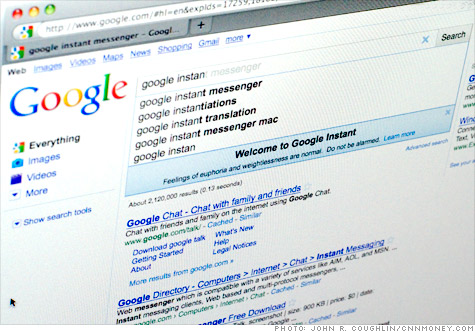
Google launches live-updating 'Instant' search


NEW YORK (CNNMoney.com) -- One of the Internet's most iconic images -- Google's search screen -- is being overhauled. On Wednesday the company launched Google Instant, a live-updating service that aims to shave seconds off the typical search time. The update began hitting users' computers about an hour before a scheduled Google press event to unveil the change.
Now, when users search Google, the results are refined in real time as more keywords are added. The search box jumps to the top of the search page and results appear in a constantly changing list. Users can select the right site if it catches their eye before they finish typing.

Frito-Lay plans to have 176 all-electric trucks in its U.S. fleet by the end of 2011.
(Credit: Smith Electric Vehicles) PepsiCo subsidiary Frito-Lay announced on Wednesday that it plans to add more than 176 all-electric trucks to its delivery fleet over the next year and a half Five all-electric trucks have been deployed for the company's New York routes this month, with plans to implement a total of 21 all-electric trucks by the end of the year that will include the company's Columbus, Ohio- and Fort Worth, Texas-area routes. Another 155 all-electric trucks will be added to Frito-Lay's U.S. fleet by the end of 2011. The company already has six EVs operating in its Canada fleet.

European Parliament passes anti-ACTA declaration

Today 377 members of the European Parliament adopted a written declaration on the Anti-Counterfeiting Trade Agreement (ACTA) in which they demand greater transparency, assert that ISPs should not up end being liable for data sent through their networks, and say that ACTA "should not force limitations upon judicial due process or weaken fundamental rights such as freedom of expression and the right to privacy."
The "written declaration" has no binding force; any MEP can issue one (there's a 200-word maximum), which is adopted when more than half of all MEPs sign on. If adopted, "written declarations are printed and posted on a board at the entrance to the Chambers in Strasbourg and Brussels." They also go up on the Web and get passed on to the European Commission.

Tuesday, September 7, 2010

Google to launch TV service in Australia next year


Google will launch its service to bring the web to TV screens in the United States before Christmas and worldwide next year, its chief executive said, as it extends its reach from the desktop to the living room.
CEO Eric Schmidt said the service, which will allow full internet browsing via the television, would be free, and Google would work with a variety of programme makers and electronics manufacturers to bring it to consumers.


Google invites Yahoo users to log into services via OpenID

Yahoo users can now use their Yahoo logins to sign up for Google services thanks to OpenID, with other providers coming soon. Google announced Tuesday that it was implementing the OpenID standard for its login process in hopes of making things easier for Internet users who have too many logins to keep track of, though whether users will actually use it remains to be seen.
For those who aren't already familiar, OpenID is a (somewhat slow-moving) movement aimed at establishing a safe, secure, and standards-based single sign-on framework for use across the Internet. The initiative allows people to sign in and access multiple websites with a single username.


HP SUES Ex-CEO Mark Hurd Over New Job At Rival Oracle


SAN FRANCISCO — Hewlett-Packard Co. is suing the chief executive it ousted last month, Mark Hurd, to stop him from taking a top job at rival Oracle Corp.
The lawsuit, filed Tuesday in a California state court, came a day after Oracle hired Hurd as co-president to help lead the database software maker's efforts to steal business from HP. HP claims that Hurd won't be able to perform his job at Oracle without spilling HP's trade secrets and violating a confidentiality agreement.

Android to control half of smartphone market, say analysts

By Larry Dignan
A bevy of Android devices will ultimately mean that Google’s mobile operating system will control largely half of the smartphone market, according to a Piper Jaffray report. Apple’s iOS will probably top out with market share of 20 percent to 30 percent in the long run.
The big picture? Android and Apple will squeeze rivals such as Nokia and Research in Motion, according to the Piper Jaffray report. These also-rans will duke it out for the 20 percent share left on the table.
Android will grab half of the smartphone market ultimately just because of its product cycle and multiple partners. The HTC, Motorola and Samsung Android device barrage is impressive. In the end, RIM and Nokia will cave and adopt Android as an operating system and give the operating system a massive market share boost


Google will face an antitrust investigation in Texas over charges that it manipulated search results, in what appears to a similar case to one pending in Europe.

Google confirmed an earlier report by Search Engine Land Friday after the close of the stock market that Texas Attorney General Greg Abbott has contacted it in connection with an "antitrust review" of Google's business practices. Earlier this year, European regulators opened an investigation regarding claims by a Microsoft-friendly price-comparison site called Foundem that Google was downranking Foundem in hopes of putting the site out of business.

Not a lot of news is happening in Australia lately regarding the mandatory web filtering. So we decided to find out if anything has happened lately. Turns out, Australia has had an election with some rather historical results that could see to the demise of the net filtering plan.
Hung parliament. The last time Australia had one of those was 1940. Still, it’s a term that Australians will now have to get use to now with no one winning a majority government.

So it sounds like the Australian internet filter, the one that would filter out “inappropriate content” and the one that could possibly even filter file-sharing content (though this was a matter of debate), is officially dead.